DCAITI
DCAITI research

Simulation and Evaluation of
Vehicle-2-x Communication Applications

One aim of the scientific and industrial automotive research is the development of applications that enhance both safety and traffic efficiency. Vehicular communication based on wireless short-ranged networks (Vehicle-2-X Communication) provides the foundation for these applications.

Realistic Simulation of V2X Communication Applications

For example, an obstacle warning application can inform other vehicles in its neighbourhood about a potentially dangerous situation before the obstacle is visible to them. Field tests are carried out to evaluate the improvements that could be achieved by these new applications. However, detailed simulations have to precede tests in the real world. Currently, different kinds of simulators are necessary for the simulation of vehicular communication. Traffic simulators are used to generate the movement of vehicles. In general, traffic simulators have no or only rudimentary functionality for the simulation of direct and multi-hop vehicular communication. Therefore, network simulators are used to simulate the communication between vehicles. Moreover, further components are necessary for the simulation of V2X Communication applications. For example, an application interface simulator can be used to integrate applications of real vehicles into the simulation environment and an environment generator to manage all map related data.

Combining Best-of-Class Simulators

One key requirement is the interaction at runtime of the simulation between network simulator, traffic simulator, and the application because modifications of traffic parameters, like movements of vehicles and characteristics of roads, need to be made at runtime. For example, when an obstacle warning application of a vehicle detects a dangerous situation, this vehicle sends a warning message to vehicles in its neighbourhood using the network simulator. As a result, receivers of this warning could, then, change their routes, which has to be fed into the traffic simulator.

Network, traffic, and application interface simulator as well as an environment generator are interconnected.
Interactions between Simulators

Our Simulation Runtime Infrastructure

Running coupled simulators synchronously is a complex problem since each simulator manages its own internal simulation time and data. The clocks of the simulators must be synchronized and, moreover, simulation data must be exchanged during runtime among simulators. Currently, most existing simulator couplings are specified for particular simulators. They are either extending an existing simulator or create a coupling among pre-defined simulators. Therefore, these simulator couplings are bound to those specific simulators.

V2X Simulation Runtime Infrastructure (VSimRTI)

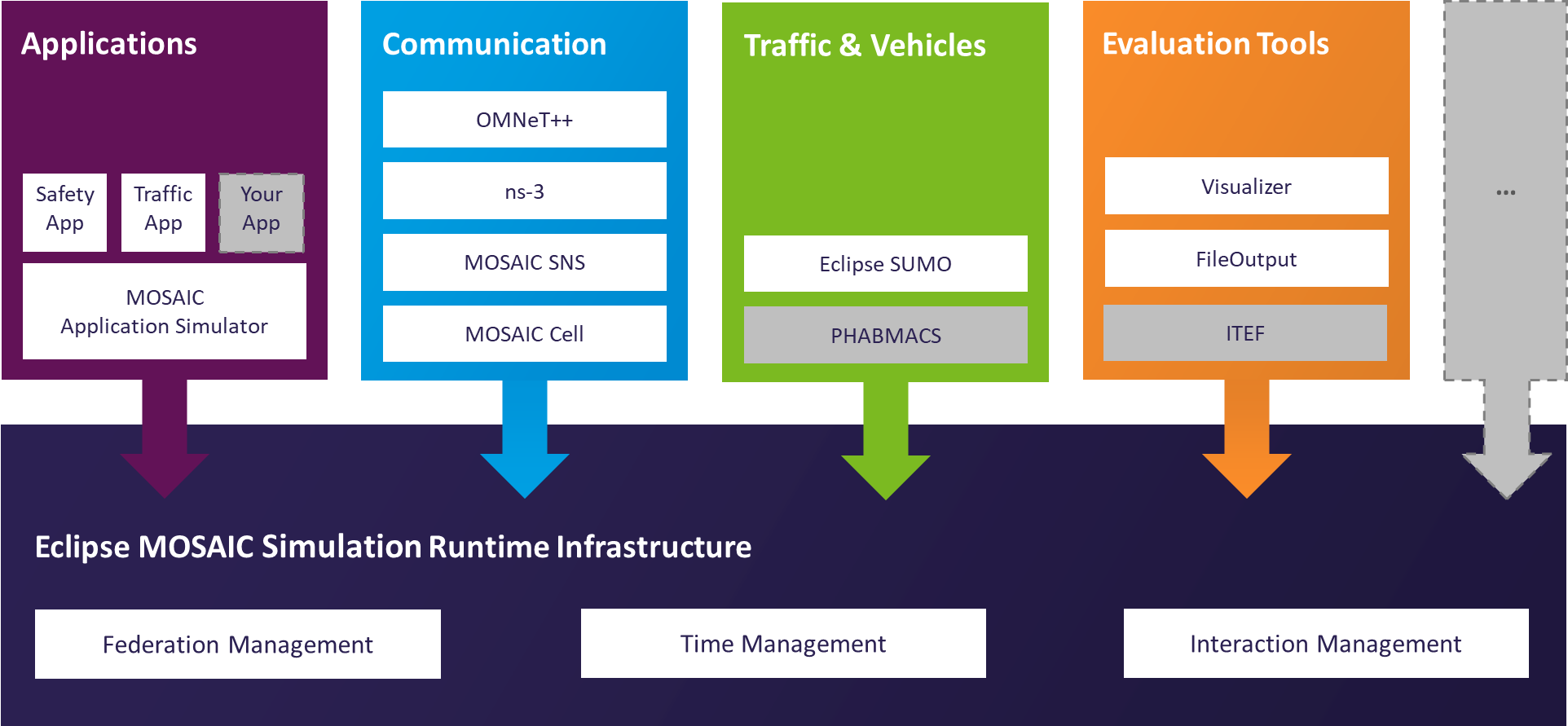
To provide the flexibility to exchange simulators, we have developed the Vehicle-2-X Simulation Runtime Infrastructure (VSimRTI). Our simulation infrastructure offers interfaces for the integration of simulators, e.g. for network, traffic, and environment simulations. It provides the flexibility to exchange them without changing the infrastructure. For the synchronization of and the communication among all components, the implemented infrastructure uses concepts defined in the IEEE standard for modelling and simulation (M&S) high level architecture (HLA). Thus, the runtime infrastructure VSimRTI allows a flexible combination of time-discrete simulators for Vehicle-2-X simulations. Based on the requirements of a concrete scenario, arbitrary simulators can be plugged onto the VSimRTI and are executed together.

General Architecture of VSimRTI

Publications

Contact